


From Nature to Craft: Basket Weaving with Mastic and Chaste Tree Branches
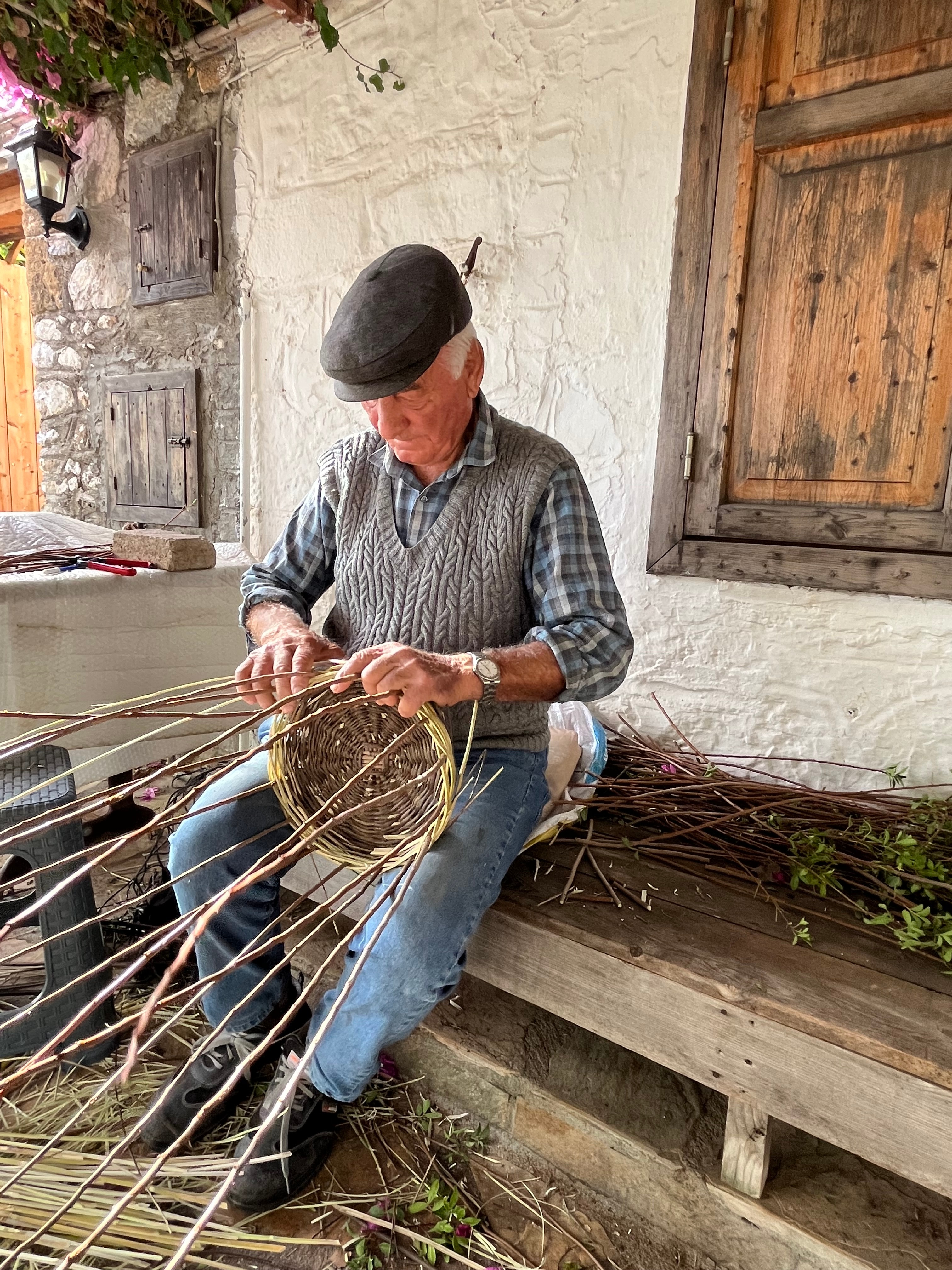
We learned basket weaving in Reşadiye, a quiet neighborhood in Datça, guided by someone whose hands seem to carry the calm of many years spent making things well. Our teacher was Ergin Bircan, a master craftsman known locally for his carpentry. What he shared with us was more than a technique. It was a way of moving through time, of working with patience, and of letting something take shape without rushing it.
We wanted to pass this experience on to you, not as a set of instructions, but as a story that still lingers with us.
At the heart of basket weaving, Ergin Usta says, are three essentials. Mastic branches, chaste tree branches, and water.
He learned this craft as a child, around the age of twelve or thirteen. Even now, the process begins the same way. First, he builds the basket’s backbone. For that structure, he uses mastic branches he gathers himself from the mountains, selecting them with the kind of attention that comes from knowing the land and the material intimately.
When we started, he picked up a mastic branch and offered a comparison that instantly made sense. “While you’re building the backbone,” he told us, “think of it as if you’re building a boat.”
A boat. Something that can carry weight. Something that needs balance. Something that must be trustworthy.
Once the backbone is in place, the chaste tree branches take over. He uses them to secure the base so it holds together firmly, and then he begins weaving with the same branches. Slowly, step by step, the basket starts to appear. It does not arrive all at once. It reveals itself gradually, as though it’s been waiting patiently under the surface.
The chaste branches are prepared the day before. He soaks them and then lets them dry again. He calls this training the material. It is a small act of care that changes everything. The branches become more pliable, easier to shape without breaking, more willing to follow the weave. And when the basket is finished, it holds its form with a quiet confidence.
One basket takes about eight hours to complete. That is why, Ergin Usta says, he can make at most two in a day. When we asked him what a typical day looks like, he smiled and spoke as if describing something simple and natural.
“I wake up at 5:00 a.m. I start working at 6:00 a.m. I go to bed early. This basket work keeps me strong. If I didn’t do it, at my age, I would struggle. And I don’t really go to the coffeehouse much.”
Reşadiye has a well known coffeehouse where the neighborhood gathers, especially the elders. It is one of those places where time is shared. But Ergin Usta chooses a different rhythm. He loves working and producing, and he plans his days around making, not passing the hours.
There is something deeply moving about watching branches come together. Pieces that, on their own, seem rigid and separate begin to bend toward one another. They interlace. They hold. They become a whole. And while you watch, certain truths start to rise to the surface.
You remember that without effort, there is no harvest.
You see how much depends on the beginning, how a strong foundation quietly shapes everything that comes after.
You feel that when someone puts something of themselves into their work, not just skill but time, attention, presence, the work carries a different weight. A different value.
What Ergin Usta brings to this craft is exactly that. Experience, skill, labor, and above all, the time he gives from his own life.
That day in Reşadiye, we learned how a basket is made. But we also left with something else. Each of us picked up different lessons about our own path. Some of those lessons can be spoken out loud. Others remain as an inner voice, the kind that stays quiet until the moment you need it. We believe those voices, in time, become a compass.
Heritage Homes Team We are grateful to our dear Ergin Usta for welcoming us into his process, for sharing his knowledge so generously, and for allowing us to pass this experience on to you. May your hands always stay strong, Ergin Usta. We are so glad you are here. With love and respect,
We wanted to pass this experience on to you, not as a set of instructions, but as a story that still lingers with us.
At the heart of basket weaving, Ergin Usta says, are three essentials. Mastic branches, chaste tree branches, and water.
He learned this craft as a child, around the age of twelve or thirteen. Even now, the process begins the same way. First, he builds the basket’s backbone. For that structure, he uses mastic branches he gathers himself from the mountains, selecting them with the kind of attention that comes from knowing the land and the material intimately.
When we started, he picked up a mastic branch and offered a comparison that instantly made sense. “While you’re building the backbone,” he told us, “think of it as if you’re building a boat.”
A boat. Something that can carry weight. Something that needs balance. Something that must be trustworthy.
Once the backbone is in place, the chaste tree branches take over. He uses them to secure the base so it holds together firmly, and then he begins weaving with the same branches. Slowly, step by step, the basket starts to appear. It does not arrive all at once. It reveals itself gradually, as though it’s been waiting patiently under the surface.
The chaste branches are prepared the day before. He soaks them and then lets them dry again. He calls this training the material. It is a small act of care that changes everything. The branches become more pliable, easier to shape without breaking, more willing to follow the weave. And when the basket is finished, it holds its form with a quiet confidence.
One basket takes about eight hours to complete. That is why, Ergin Usta says, he can make at most two in a day. When we asked him what a typical day looks like, he smiled and spoke as if describing something simple and natural.
“I wake up at 5:00 a.m. I start working at 6:00 a.m. I go to bed early. This basket work keeps me strong. If I didn’t do it, at my age, I would struggle. And I don’t really go to the coffeehouse much.”
Reşadiye has a well known coffeehouse where the neighborhood gathers, especially the elders. It is one of those places where time is shared. But Ergin Usta chooses a different rhythm. He loves working and producing, and he plans his days around making, not passing the hours.
There is something deeply moving about watching branches come together. Pieces that, on their own, seem rigid and separate begin to bend toward one another. They interlace. They hold. They become a whole. And while you watch, certain truths start to rise to the surface.
You remember that without effort, there is no harvest.
You see how much depends on the beginning, how a strong foundation quietly shapes everything that comes after.
You feel that when someone puts something of themselves into their work, not just skill but time, attention, presence, the work carries a different weight. A different value.
What Ergin Usta brings to this craft is exactly that. Experience, skill, labor, and above all, the time he gives from his own life.
That day in Reşadiye, we learned how a basket is made. But we also left with something else. Each of us picked up different lessons about our own path. Some of those lessons can be spoken out loud. Others remain as an inner voice, the kind that stays quiet until the moment you need it. We believe those voices, in time, become a compass.
Heritage Homes Team We are grateful to our dear Ergin Usta for welcoming us into his process, for sharing his knowledge so generously, and for allowing us to pass this experience on to you. May your hands always stay strong, Ergin Usta. We are so glad you are here. With love and respect,

ALL POSTS




@HERITAGEHOMES


 CALL
CALL
 WHATSAPP